



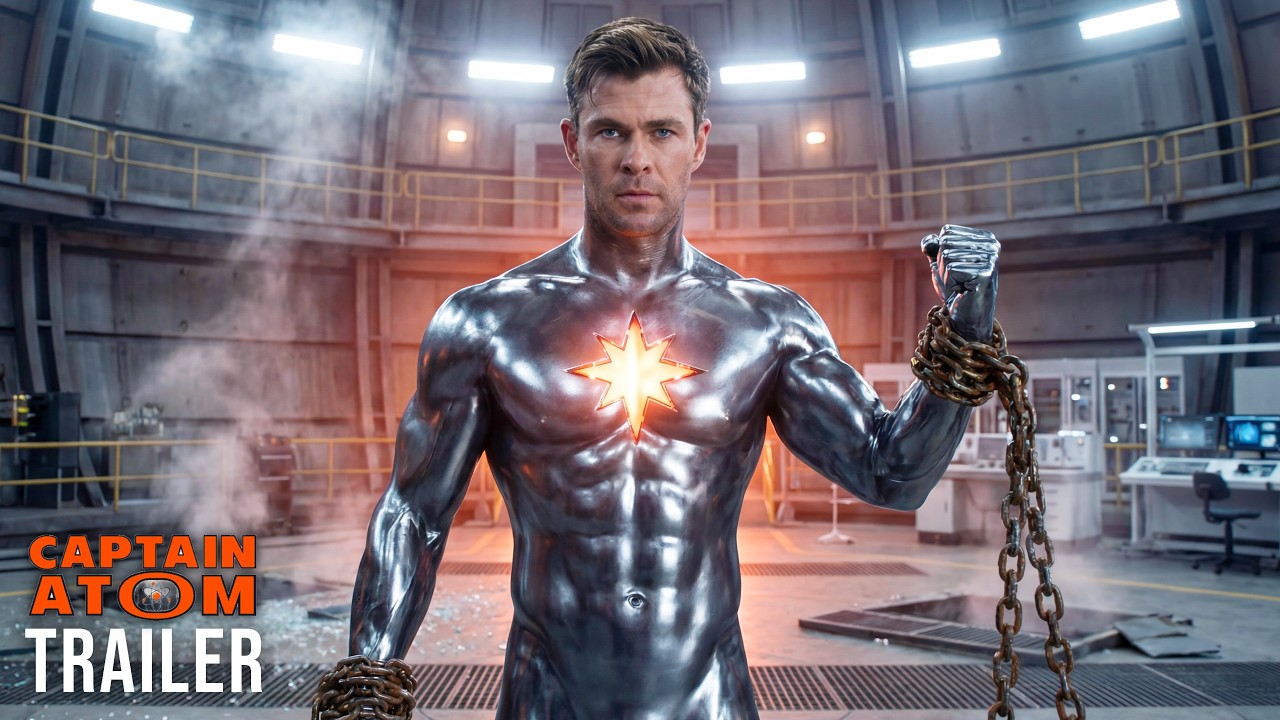
An Origin Story That Refuses Comfort
There are superhero films that announce themselves with thunder, and then there are those that creep in quietly, carrying dread instead of spectacle. Captain Atom (2026) belongs firmly to the latter category. From its opening moments, the film establishes a tone that is cold, controlled, and deeply unsettling. This is not a story about discovering heroism. It is a story about surviving transformation.

The inciting incident is deceptively simple: a government experiment conducted behind sealed doors, meant to harness energy, control it, weaponize it. Something goes wrong. And unlike most cinematic accidents, it does not stop going wrong. Reality itself seems to splinter in response, bending and stuttering as if unsure how to exist around its new creation.

Chris Hemsworth’s Most Restrained Performance
Chris Hemsworth steps into the role of Captain Atom with a surprising and welcome restraint. Audiences accustomed to his charismatic bravado may be caught off guard by how inward this performance is. His Captain Atom does not posture or preach. He watches. He listens. He fears.

What makes Hemsworth compelling here is the constant suggestion that his character is barely holding himself together. Power leaks from him like radiation from a cracked reactor. His expressions convey not confidence but calculation, as if every breath is measured to prevent catastrophe.
- A subdued physical performance that emphasizes stillness over action
- Facial expressions that communicate dread, isolation, and guilt
- A complete absence of swagger, replaced by quiet desperation
Power Without Limits, Control Without Certainty
The film’s most striking achievement is how it visualizes godlike power without indulging in excess. Time stutters mid-scene. Light fractures into impossible angles. Energy hums beneath dialogue like a warning siren. These effects are not flashy distractions; they are narrative tools, constantly reminding us that Captain Atom’s existence is a destabilizing force.
Importantly, the story is not about learning how to fight. It is about learning how not to erase everything nearby. Every sequence seems to ask whether containment is even possible, or whether humanity has crossed a line it can no longer retreat from.
An Atmosphere of Surveillance and Fear
What makes Captain Atom genuinely unsettling is what it withholds. We are never fully told who is watching, who is afraid, or who is waiting for failure. The camera frequently lingers on observation rooms, sealed corridors, and silent figures behind glass. Captain Atom is treated less like a person and more like a ticking clock.
The atmosphere is deliberately clinical. Cold lighting, sterile environments, and minimal musical cues create a suffocating sense of isolation. Power here is not freedom. It is confinement. The film suggests that once something surpasses human limits, it can never again belong to humanity.
Thematic Undercurrents
- The ethical cost of unchecked scientific ambition
- The fear of creations that outgrow their creators
- Isolation as the true consequence of absolute power
A Superhero Film That Thinks Like Science Fiction
In spirit, Captain Atom feels closer to classic science fiction than modern superhero cinema. It echoes stories where power is a burden rather than a wish fulfilled. The film is patient, content to let silence speak louder than exposition. When questions are raised, they are rarely answered outright.
This refusal to explain everything is a strength. The unease comes from uncertainty, from the sense that even the people in control rooms do not fully understand what they have unleashed. Captain Atom himself becomes a mirror for that anxiety, a man trapped inside something infinite.
A Final Act That Lingers
The closing moments are striking precisely because they avoid spectacle. There is no triumphant battle, no clean resolution. Instead, the film ends on sustained tension: energy humming, systems failing, and a look on Hemsworth’s face that suggests permanence. Whatever has happened here cannot be undone.
It is a bold ending, one that trusts the audience to sit with discomfort rather than relief. Like the best films in the genre, it lingers not because of what it shows, but because of what it implies.
Final Verdict
Captain Atom (2026) is an emotionally charged, intellectually ambitious entry into superhero cinema. It trades noise for nuance and spectacle for consequence. Anchored by a haunting performance from Chris Hemsworth and a tone that never flinches, the film asks a timeless question: what happens when humanity creates something it cannot stop?
Early Rating: 9.3/10